

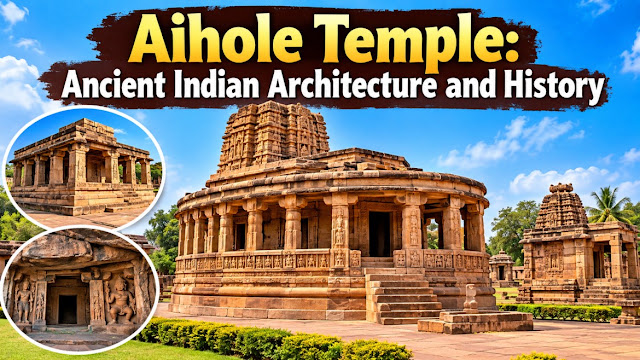

Have you ever found yourself face-to-face with an ancient temple wondering how exactly it was built?
In this regard, the Aihole Temple is a real find as it displays ancient Indian craftsmanship, devotion, construction techniques, and even diverse aesthetic views.
Located in Bagalkot district of Karnataka, this place is famous for its rock-cut temples and other historical monuments associated with the region’s early cultural development.
It is noteworthy that more than a hundred and twenty-five temples are linked to Aihole making it a center of the ancient culture.
However, this archaeological site has another claim to fame as it seems to be a cradle of diverse architectural experiments.
Aihole Temple and its Ancient Story
The Aihole Temple history is inextricably linked with the Early Chalukyas.
This ancient culture created unique architectural designs experimenting with different shapes, sizes, and construction techniques.
As a result, one can see how various temple building plans developed.
It may not be possible to see everything at once, but each structure has its story to tell.
UNESCO notes that Aihole, together with Badami and Pattadakal, represents “an outstanding example of early Hindu rock-cut and structural temple architecture.”
Thus, one can easily imagine how a bygone era architect could look with awe at his future masterpiece wondering how he could improve upon it.
The Famous Durga Temple
Speaking of Durga Temple, it is one of the most notable monuments in Aihole.
At first glance, this structure is quite simple, but it has one particular feature attracting visitors’ attention.
It has an unusual apsidal plan with a pillared veranda surrounding the main shrine.
Looking at the temple from different angles, one gets various impressions as if it were many different buildings.
Moreover, the name Durga Temple could be misleading as it is not really associated with the goddess Durga.
This name refers to the local language word “durg” meaning fortification or fortified place, not the goddess.
This fact makes one think how vast and complex the history of architecture could be.
Lad Khan Temple Has Its Unique Character
It is impossible to get to know Aihole and its ancient history without mentioning such an impressive monument as the Lad Khan Temple.
It has a unique design and proportions made of large stone blocks.
A careful observation of this structure may show how its architectural design evolved.
According to Karnataka Tourism, this monument is one of the oldest in the region and used to serve as both an assembly hall and a marriage palace.
Looking at the Lad Khan Temple, one can only express admiration for the quality of work that ancient craftsmen had.
It seems that they were masters of their trade as stone blocks fit perfectly with each other allowing the masons to achieve unparalleled precision.
It is hard to realize how they managed to develop such an advanced architectural design.
Aihole Was Like an Ancient Design Workshop
Saying that Aihole is a cradle of architectural experiments, one could call it an ancient design workshop.
It is difficult to imagine how an architect could operate without the benefit of modern equipment in an era when even a simple mistake could be almost impossible to correct.
Designing a building using stone blocks implies a high level of design and masonry knowledge.
The masons should be able to carve the stone with millimeter precision.
Moreover, prior to actual building design, a working drawing should be made.
All these challenges could not be enough for the stone mason, but they were overcome by the ancient builders.
According to UNESCO records, Aihole and Badami are ancient workshops where the first experiments in architectural development took place, while later findings in Pattadakal represent a more refined structural design.
Thus, it seems that the legacy of these ancient constructions lives on in the present times teaching modern architects a lot about the masonry art.
Meguti Temple and Ravanaphadi Cave
Apart from the aforementioned cultural and historical significance, Aihole is also famous for its ancient carvings.
The Meguti Jain Temple is an example of how ancient people took care of preserving their cultural heritage.
This temple is located on a hillside and has an inscribed stone tablet dating back to the Chalukya period.
It is this tablet that provides historians with information about the medieval past of this place.
Another notable object of Aihole is the Ravanaphadi Cave which is considered to be a prime example of rock-cut construction.
Unlike most other temples in this region, Ravanaphadi Cave is excavated in a rock.
The inner walls of this cave are decorated with exquisite Hindu temple carvings.
Being in this place makes one realize how diverse the cultural and architectural legacy of ancient India could be.
Why Aihole Temple Is Special
Many ancient temples possess a rich history.
However, only a few of them can boast an extensive list of historical and cultural values as Aihole does.
From a visitor’s perspective, the richness of this place’s history is reflected in the variety of its architectural designs.
Some buildings may seem modest at first glance, while others will impress you with their complex construction.
Moreover, the ability to observe different types of construction within the same territory is a huge advantage of visiting Aihole.
It seems that the purpose of creating these numerous monuments was not only to build impressive structures.
The creators of these ancient buildings were true innovators who did not fear difficulties and brought ancient Indian architecture to a new level.
Great ideas do not come suddenly, they are the result of continuous improvement born out of thin air.
Aihole, Badami and Pattadakal
It is also worth mentioning that Aihole is not separated from the other two archaeological sites of this region, namely Badami and Pattadakal.
This area possesses a large concentration of monuments linked to the early Deccan temple architecture development.
UNESCO documentation highlights that “the wealth of early temple styles in this group of monuments is a remarkable testimony to the evolution of Hindu temples in Karnataka under the rule of the Early Chalukyas.”
This fact speaks for itself showing how unique the Aihole cultural legacy is.
Conclusion
To sum up, Aihole Temple represents not only an ancient architectural design but also a unique cultural and historical value.
With its diverse construction techniques, this place accommodates the richness of the ancient Indian culture.
Its historical temples, including Durga, Lad Khan, Meguti Jain temples, and the Ravanaphadi Cave, reflect different sides of the ancient world.
It seems that the main secret of creating such impressive buildings is observing details as these minute architectural changes made people realize the importance of developing a standard building design.
Perhaps this is the main reason for visiting Aihole as one can get amazed by the beauty of simple structures and try to understand the essence of architecture.
https://www.somyacorner.in/2026/09/swayambhu-mahachaitya-temple-sacred.html
https://www.somyacorner.in/2026/09/dedduwa-lake-quiet-side-of-sri-lanka.html