

The temple has been rebuilt, destroyed, and reconstituted even across centuries. But there are reasons, that people continue to come here.
For most people, it is the moment, when they have entered Varanasi. It is not the best introduction to the city or its people, its history and culture, even. Only that they have arrived. The narrow alleys echo the clang of bells and clangor of ghats at a distance, and a strange kind of music called Sanskrit floats in and out of the alleys – some of the oldest continuously existing in the country. And in this mélange, the Kashi Vishwanath temple rises, small and ancient, its golden dome overwhelming the senses.
The Kashi Vishwanath temple is not only one of India’s most popular pilgrimage sites, but one of its oldest continuously standing places of worship. Its roots trace back to over three thousand years, as the first shrine dedicated to Lord Shiva, the supreme deity of Hinduism, who has been worshipped in his various manifestations as the Lord of the Universe, the creator and destroyer of worlds, and the giver of life. The place is a magnet for those who want to visit one of the twelve Jyotirlingas, or the lingams of infinite light, said to have manifested themselves from the body of Lord Shiva, and which are sought after by millions of faithful Hindus.
The Kashi Vishwanath jyotirlinga, which is said to house the Taraka mantra in the ears of every dying person, is a city in itself, for it is believed that dying here in Kashi grants moksha, that is, freedom from the cycle of rebirth and reincarnation. This belief has made the place a coveted destination for millions of faithful Hindus, who have crossed oceans and centuries to come here.
What the Kashi Vishwanath really is
The Kashi Vishwanath temple, dedicated to Lord Shiva in his manifestation as “Vishwanath” – the Lord of the Universe, is located in the ancient city of Varanasi, also known as Kashi, on the western banks of the holy river Ganga, in the state of Uttar Pradesh.
The temple, one of the twelve jyotirlingas, or the lingams of infinite light said to have manifested themselves from the body of Lord Shiva are the most sought after by millions of faithful Hindus. The Kashi Vishwanath temple, according to legend, has a unique significance in Hindu mythology, as it is believed that dying in Kashi grants moksha, or freedom from the cycle of rebirth and reincarnation.
This belief has made the place a coveted destination for millions of faithful Hindus, who have crossed oceans and centuries to come here.
A temple with a violent history
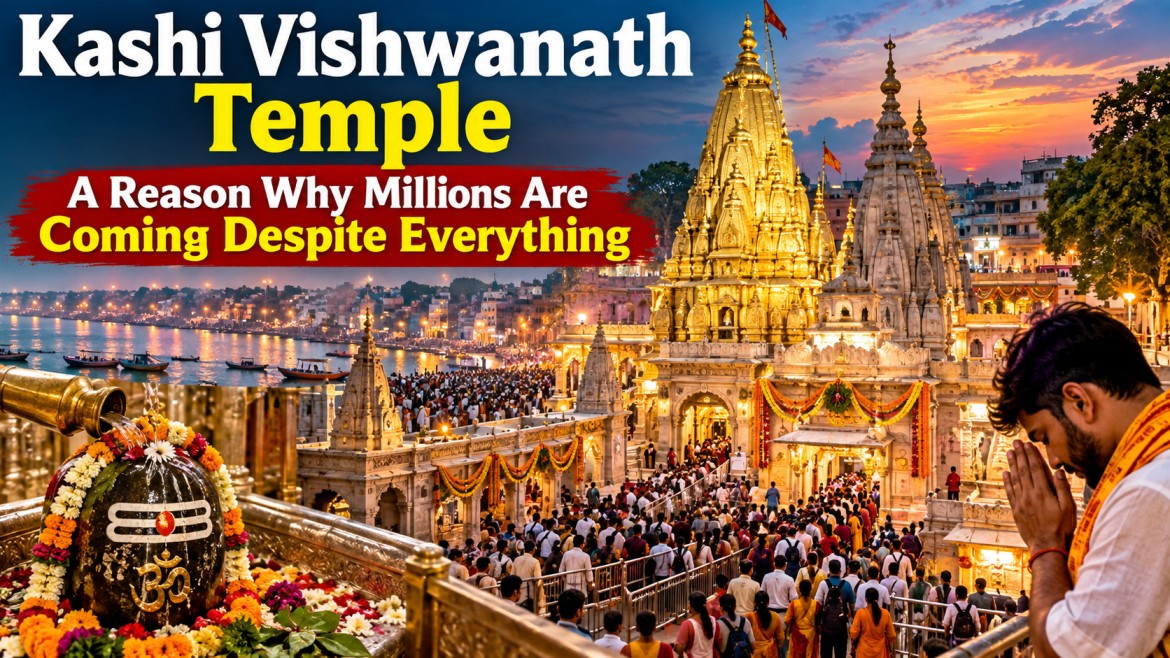
The Kashi Vishwanath temple, one of the oldest places of worship in India, has been destroyed and reconstituted many times over the centuries. It was razed and rebuilt by the Mughal emperor Aurangzeb in 1669, who built a mosque on its ruins. The mosque still stands today, alongside the current temple complex. The current temple complex was built in 1780, by Maharani Ahilyabai Holkar of Indore, who used her private funds to do so. The gold dome of the Kashi Vishwanath temple, which is visible in most photographs of the temple, was added in the 19th century by the Maharaja of Punjab, Ranjit Singh, who donated gold from Punjab to the shikhara of the temple.
Knowing this history of the Kashi Vishwanath temple complex, is important to understanding why it is so dear to the hearts of millions of Indians, and why it has so many visitors even today. It is not just a temple complex well-preserved behind glass cases, but a living entity that has been built, destroyed and rebuilt by people from different walks of life, all of whom believed in its importance and its divine power.
The Kashi Vishwanath Corridor and what has changed
Until recently, the Kashi Vishwanath temple was located in the heart of one of the busiest commercial hubs of Varanasi, surrounded by hundreds of densely populated neighborhoods.
In December 2021, Prime Minister Narendra Modi unveiled the Kashi Vishwanath Corridor, which is a large-scale development project that has transformed the area around the temple into a bustling commercial district.
Several thousand buildings have been acquired and demolished to create this corridor, which connects the Kashi Vishwanath temple to the Ganga river at Lalita Ghat. The development has also created several plazas, rest areas, and galleries, as well as providing a clear view of the sanctum sanctorum of the temple.
The number of visitors to the temple has grown exponentially since the inauguration of this corridor, with figures regularly cited in the range of one lakh visitors in a day. The festival days and occasions such as Maha Shivaratri witness the maximum number of visitors.
There are those, however, who miss the old labyrinthine alleys that once led to the temple, and who feel that the newer developments have made the Kashi Vishwanath temple a place that is less accessible to the common people.
What the darshan feels like
You line up, and wait. The waiting time depends on the time of the day, and the type of entry you have chosen. General queues, VIPs and managed queues. Security checks are extensive, and you will not be allowed to bring your phone into the temple.
The inner sanctum, however, is surprisingly small – for those who have only seen pictures of the golden spire, and imagined themselves standing before a vast and magnificent structure. The Shivalinga, the symbol of Shiva, is surrounded by crowds of devotees who come to pay homage to the deity at almost every hour the temple is open. You move, and are moved, as the priests lead you with efficiency and force. You have only a few seconds to take in the image of the deity, for the next person will be right behind you.
But all of that is secondary to the feeling of the darshan – the moment when your senses are overwhelmed, and the only thing that remains is the feeling of the deity. It is an experience that is difficult to describe, and even more difficult to capture on film. The entire journey – from wherever you have come from – has led you here, and it ends in a few seconds. You emerge from the chaos of Varanasi into the courtyard with the golden dome above you, and the Ganga somewhere in the distance, from where you have come.
People always cry, not always knowing why.
Why pilgrimage to Varanasi is different
Most sacred sites offer you something – a feeling of peace and a beautiful landscape. Some offer a beautiful building to admire and a wonderful ritual to participate in.
Kashi, however, does not offer you anything. It is not comfortable, but it is overwhelming. The ghats of the morning have boats of people who have come to be cremated. The lanes of Varanasi smell of marigold flowers and smoke. The entire city is a crucible of life and death, birth and death, devotion and commerce, all happening in an area the size of a square.
The significance of Kashi Vishwanath cannot be separated from the significance of Kashi itself. According to Hindu philosophy, this city is outside the normal laws of the world, as it is held on the trident of Shiva, the creator and destroyer of the universe. Whether you believe that literally or metaphorically speaking, its effect on the visitor is the same. It has withstood the test of time, and has witnessed countless people walking its narrow alleys, their lives unfolding in this space.
There is a certain kind of feeling that you get when you visit Kashi, which is not really possible anywhere else.
The practical information worth knowing
Location: Vishwanath Gali, Varanasi, Uttar Pradesh. Near Dasaswamedh ghat, with multiple entry points.
Temple timings: The temple opens very early, as the darshan is available from around 2:30 AM for the Mangala Aarti, and four major aarti sessions are conducted. The morning and evening aarti attract the most crowds.
Best time to visit: October to March, as the weather in Varanasi is comparatively pleasant during these months. Maha Shivaratri is a major festival that attracts large crowds from all over India, and if you want to experience it, you should plan your trip months in advance. If you want to experience a less crowded darshan, the best time is an early morning on a weekday during the winter.
Getting there: The best way to reach Varanasi is via the Lal Bahadur Shastri airport, which has direct flights from most major Indian cities. The city is also well-connected by rail, and the distance from the railway station to the temple area is about 5-6 km, with the last few kilometers having to be traversed on foot or in a cycle rickshaw.
What to bring: You will not be allowed to bring any electronic devices into the temple, and so it is a good idea to leave your phone in a locker outside the temple area. You should carry valid ID, and dress modestly. If you want to experience the Ganga Aarti at Dasaswamedh ghat in the same evening, you should plan your day around it, as the two events are worth experiencing together.
The human need behind the pilgrimage
There is one question that seems to haunt people about why, despite the incredible advances in technology and access to information and images of all kinds, millions of people continue to make the effort to travel to the Kashi Vishwanath temple each year.
Part of it is tradition and family values – family pilgrimage patterns that are passed down through generations. Part of it is devotion – faith without any rational justification. But there is something else too. Pilgrimage requires a kind of presence that is difficult to achieve in our modern world. You have traveled to get here, and you have stood in a queue for hours. You do not have a phone, and the place that you are visiting smells of incense and the river, and the crowded area around you consists of people who have come from other places, and who are all headed for the small room where a stone pillar is surrounded by offerings. The total commitment of the environment towards one moment is rare. Our experiences so often tend to be layered, as we are multi-tasking, checking things, and recording them, while we are in the moment. A darshan at Kashi Vishwanath is not something that can happen that way.
Perhaps that is why people come back. Not always for faith, but for the memory of having been somewhere completely present.
What the temple asks of you
The Kashi Vishwanath temple, dedicated to Lord Shiva in his manifestation as “Vishwanath” – the Lord of the Universe, has been a coveted destination for millions of faithful Hindus, who have crossed oceans and centuries to come here.
The temple complex, which has been destroyed and reconstituted many times over the centuries, is well-preserved behind glass cases, but it is also a living entity that has been built, destroyed and rebuilt by people from different walks of life, all of whom believed in its importance and its divine power.
You can visit as a tourist and find it interesting, and you can visit as a devotee and find it transformative, but either way, you will remember it. That much is almost universal among people who have made the journey to the Kashi Vishwanath temple, and whatever they came looking for, they have found something to take with them from the place.
And that, perhaps, is what three thousand years of pilgrimage really look like from the inside.
Har Har Mahadev.